





Project Profile for Neera Production
About Neera Video Films on Neera
 Healthy Ways Newsletter Vol 10-3 |
 MB.com 17-7-14 |
 Naturalnew.com 20-11-13 |
|
Indian
Coconut Journal (English) Neera Special Issue May 2013 |
Indian
Nalikera Journal (Malayalam) Neera Special Issue May 2013 |
 |
 |
 |
 |
 |
 |
 |
|

 Nutritional Outlook,com 12-6-15 |
 Plant Hortitech Mar-14 |
 NufFood Spectrum May-15 |
 newsmax-health 25-5-15 |
 The Hindu 14-5-15 |
 DowntoEarth.org.in Apr-15 |
 The Hindu 23-1-15 |
 Deccan Herald 30-8-14 |
 The Hindu 2-9-14 |
 The Hindu 3-9-14 |
 Deccan Herald 30-3-15 |
 New Indian Express 27-7-14 |
 Mathrubhumi 4-9-15 |
|
 Coconut
Neera production and processing in Karnataka - Indian
Coconut Journal Jan 2013
Coconut
Neera production and processing in Karnataka - Indian
Coconut Journal Jan 2013
Unite,
Think big and Win big - Indian
Coconut Journal Jan 2013
Production
of Neera and its Value addition - Indian
Coconut Journal May 2009
Bio
Beverage - Coco Neera - Indian
Coconut Journal November 2004
Tamil Articles

Malayalam Articles
| About Neera in Malayalam | Article on Neera in Malayalam | Article on Neera in Malayalam |
|
Indian
Nalikera Journal (Malayalam) Neera Special Issue May 2013 |
 Kerala Karshakan - June-13 |
 Indian Nalikera Journal May-2013 |
 Indian Nalikera Journal May-2013 |
 Indian Nalikera Journal May-2013 |
 Indian Nalikera Journal May-2013 |
 Indian Nalikera Journal May-2013 |
 Indian Nalikera Journal May-2013 |
 Indian Nalikera Journal May-2013 |
 Indian Nalikera Journal May-2013 |
 Indian Nalikera Journal May-2013 |
 Indian Nalikera Journal May-2013 |
 Indian Nalikera Journal May-2013 |
 Indian Nalikera Journal May-2013 |
 Indian Nalikera Journal May-2013 |
 Insurance Master Aug-13 |
 Krishikkaran Aug-13 |
 Krishikkaran Aug-13 |
 Kalaveekshanam - June-13 |
 Karshakan May-2013 |
 Karshakan May-2013 |
 Karshakan May-2013 |
 Karshakan May-2013 |
 Karshakan May-2013 |
 Karshakan May-2013 |
 Kerala Karshakan May-13 |
Mathrubhumi 30-4-13 |

 Mathrubhumi 6-4-13 |
 Harithabhumi Apr-13 |
 Harithabhumi Apr-13 |
|
Kerala Karshakan Mar-13 |
 Karshakasree Feb-13 |
 India Today 27-2-13 |

|
Karshakasree Dec-12 |
Business Deepika - Oct-Nov 12 |
Mathrubhumi 17-10-12 |


 Mathrubhumi 5-5-14 |
 Karshakan March-14 |
 Karshakan March-14 |
 Business Deepika Apr-14 |
 Green Leaf - March-14 |
 Janmabhumi 22-4-14 |
 Karshakasree Apr-14 |
 Dhanam - March-14 |
 Business Deepika Apr-14 |
 Saphalyam-Sept-14 |
 Yoganadam July-14 |
 Business Deepika Aug-14 |
 Indian Nalikera Journal Sept-2013 |
 Deepika 3-12-2014 |
 Deepika 4-12-2014 |
 Manorama Aarogyam Apr-15 |
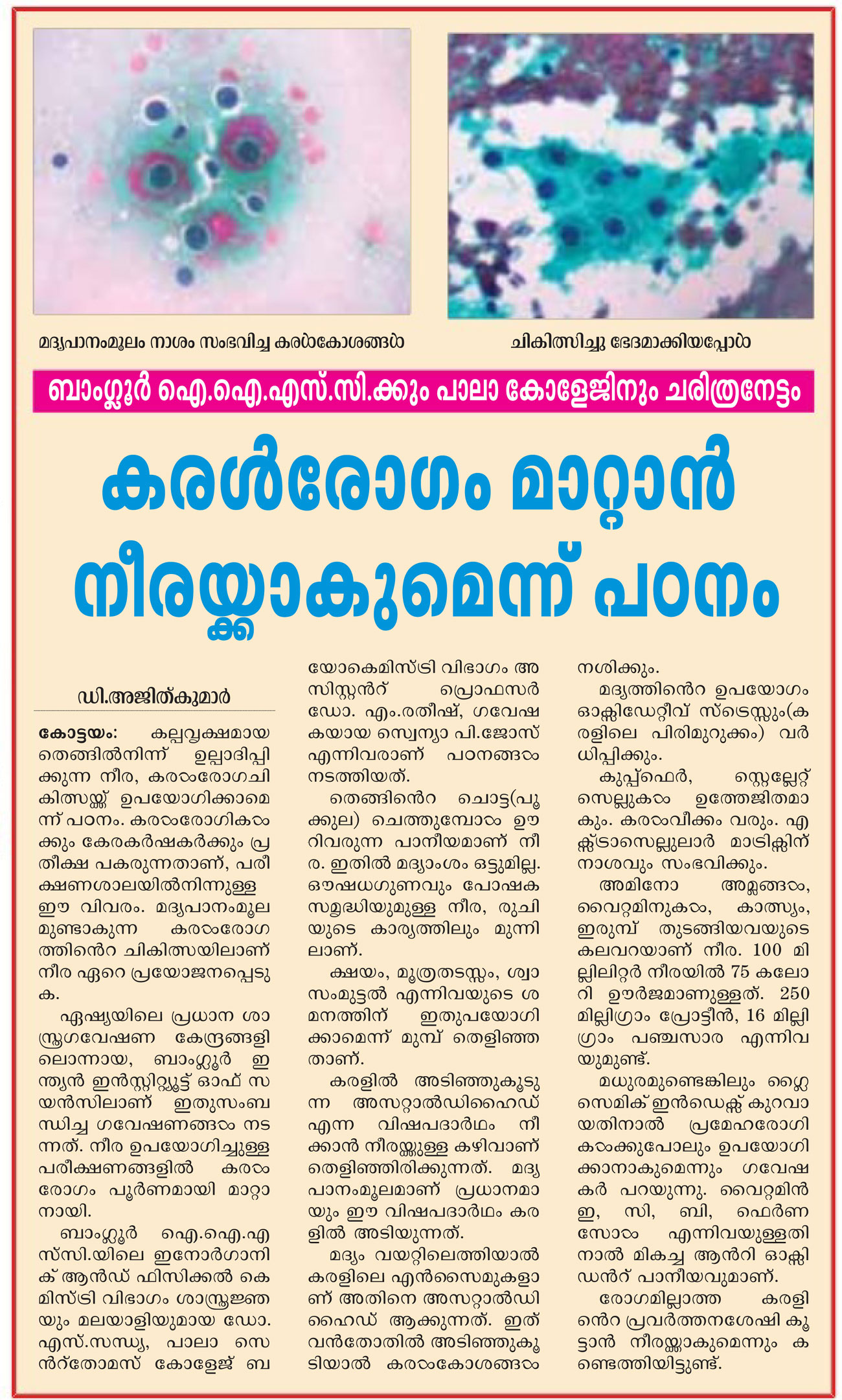 Mathrubhumi 4-9-15 |
 Malayala Manorama-15-12-15 |
Neerayum
Vivadangalum - Harithasena, Kozhikode
Neera
Enthe? Enthine? - K.Govindan Nair
Aikya
Janathipathya Munnaniyude Prakadana Patrikayil
Neera
Neera
- Uthbhavam - V.
Mithranneera-ulbhavam-v-mithran.pdf
Neera
Discussion
held at Tvm on 20-3-13
Presentations - Symposium on Possibilities of Neera held on 27th April 2013 at Ernakulam
(1) Coconut
Inflorescence Sap Products - Neera (Keramithram),
Palm Jaggery (Kerachakkara)
- by Dr.V.K. Raju, Kerala Agri. University
(2) Neera and its Products in International Trade - by Smt.S.Deepthi Nair, Marketing Officer
Neera Posters (click to enlarge)



Photos
Neera products


Neera in packets produced by Karnataka Govt.


Organic Coconut Palm
Sugar
Coconut palm sugar

 Neera
(Coconut Flower Sap)
Neera
(Coconut Flower Sap)
Neera, the non-alcoholic and nutritious drink from the immature inflorescence of coconut can be promoted due to its potential for value addition, employment generation and better returns to the coconut farmers. The vascular sap collected from immature unopened coconut inflorescence is popularly known as “Neera” in fresh form. It is a sugar containing juice, a delicious health drink and a rich source of sugars, minerals and vitamins. It is sweet and oyster white in colour and translucent. It is tapped from the coconut inflorescence filtered, pasteurized, and bio preservatives added to preserve the product. Treated Neera can be preserved in cans upto 2 months at room temperature.

Neera bottled by
Kerala Agricultural University
Uses of Neera
Neera is popular as a delicious health drink. It is good for digestion, facilitates clear urination and prevents jaundice. The nutrient-rich "sap" has low Glycemic Index (GI of only 35) and hence diabetic-friendly since very low amounts of the sugar is absorbed into the blood. It is an abundant source of minerals, 17 amino acids, vitamin C, broad-spectrum B vitamins, and has a nearly neutral pH. Diversified Value Added Products like coconut flower syrup, jaggery and coconut palm sugar are produced from Neera.
Composition of Neera
| Total solids (g/100ml) | 15.2 - 19.7 |
| pH | 3.9 - 4.7 |
| Specific gravity | 1.058 - 1.077 |
| Total sugars (g/100ml) | 14.40 |
| Original reducing sugars (g/100ml) | 5.58 |
| Total reducing sugars (g/100ml) | 9.85 |
| Total ash (g/100ml) | 0.11 - 0.41 |
| Citric acid (g/100ml) | 0.50 |
| Alpohol in % | nil |
| Iron (g/100ml) | 0.15 |
| Phosphorus (g/100ml) | 7.59 |
| Ascorbic acid (mg/100ml) | 16.30 |
| Total protein (g/100ml) | 0.23 - 0.32 |
Coconut Flower Syrup
This is a product similar to coconut palm jaggery with high content of minerals. It is a rich source of potassium. It has good content of sodium and is free from total fats and cholesterol. It is produced when fresh Neera is heated and concentrated into a syrup.
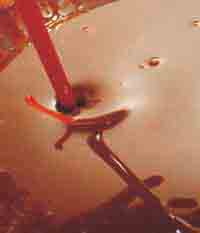
Uses of coconut syrup
The product can be used for healthy food preparations, as topping on wide variety of appetizer, dessert or beverage, for delicious serving and for a healthy lifestyle. It is also used as a health drink in connection with Ayurveda and other systems of medicine.
Coconut Palm Jaggery
The strained unfermented coconut sap is boiled, crystallized and transferred into suitable moulds to prepare jaggery. The semisolid jaggery solidifies gradually by the cooling effect of the atmosphere into a crystallized hard substance. The recovery of jaggery from syrup is 15%. It is used as a sweetening agent for the preparation of dishes and is superior to cane jaggery.
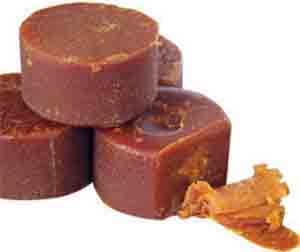
Nutritional composition of coconut palm jaggery (in 100g)
|
Component |
Qty in mg |
|
Thiamine |
21.00 |
|
Riboflavin |
432.00 |
|
Nicotinic acid |
5.24 |
|
Ascorbic acid |
11.00 |
Coconut Palm
Sugar
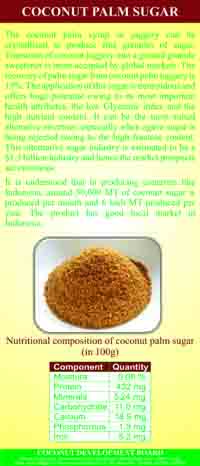
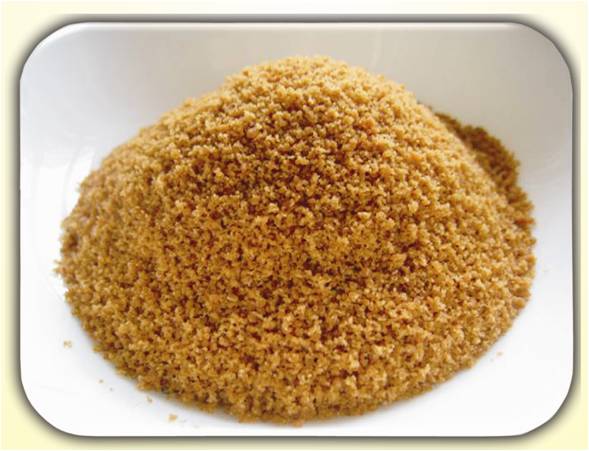
The coconut palm syrup or jaggery can be crystallized to produce fine granules of sugar. Transition of coconut jaggery into a ground granule sweetener is more accepted by global markets. The recovery of palm sugar from coconut palm jaggery is 15%. The application of this sugar is tremendous and offers huge potential owing to its most important health attributes, the low Glycemic index and the high nutrient content. It can be the most suited alternative sweetner, especially when agave sugar is being rejected owing to the high fructose content. This alternative sugar industry is estimated to be a $1.3 billion industry and hence the market prospects are enormous. It is understood that in producing countries like Indonesia, around 50,000 MT of coconut sugar is produced per month and 6 lakh MT produced per year. The product has good local market in Indonesia.
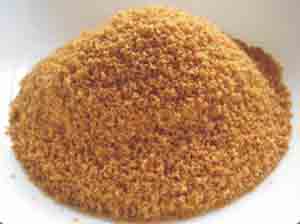
Nutritional composition of coconut palm sugar (in 100g)
| Component | Qty in mg |
| Moisture | 0.06% |
| Protein | 432 mg |
| Minerals | 5.24 mg |
| Carbohydrate | 11.0 mg |
| Calcium | 18.9 mg |
| Phosphorous | 1.9 mg |
| Iron | 5.2 mg |
Economics of production of Neera* and value added products from Neera
| Assumptions | |
| Number of palms per hectare | 175 |
| Total number of palms tapped in a hectare | limited to 80 |
| Number of inflorescence tapped per tree per annum | 3 |
| Average productivity per ha in Kerala | 7365 nuts/year |
| Approximate cost of one litre of Neera | Rs.50 |
| Conversion ratio from Neera to jaggery | 6:1 |
| Approximate cost of one kg of coconut palm jaggery | Rs.250 |
*Commercialization of Neera is possible only after amendment of Abkari Act.
Estimated returns from Neera
| Item | Yield of Neera | ||
| Yield of Neera in Litres | @1 litre/ tree/day | @2 litre/ tree/day | @3 litre/ tree/day |
| Yield of Neera from 80 palm tapped for 3 months | 7200 litres | 14400 litres | 21600 litres |
| Returns from Neera @ Rs.50 per litre | 3.6 lakhs | 7.2 lakhs | 10.8 lakhs |
| Returns per palm | Rs.4500 | Rs.9000 | Rs.13500 |
| Returns to farmer in the proportion of 75% of production | 2.7 lakhs | 5.4 lakhs | 8.1 lakhs |
| Returns to tapper in the proportion of 25% of production | 0.9 lakhs | 1.8 lakhs | 2.7 lakhs |
Estimated returns from coconut palm jaggery
| Item | Production of Neera at | ||
| @1 litre/ tree/day | @2 litre/ tree/day | @3 litre/ tree/day | |
| Yield of jaggery in kg | 1200kg | 2400kg | 3600kg |
| Returns from jaggery @ Rs.250 per kg | 3.0 lakhs | 6.0 lakhs | 9.0 lakhs |
Tapping of 25% of inflorescences (3 inflorescence) in a palm for production of Neera will yield additional income to the farmer and to the tapper, without much reduction in yield. The Coconut farmer communities in the Federations of CPS can work out a viable proportion of production of Neera and jaggery so that the products can cater to defined segments of the society. Neera being a sweet and nutritious health drink can be promoted among all sections of the society. Coconut palm jaggery owing to their low Glycemic Index can be positioned as a safe and healthy alternative sweetener. If we convert jaggery further to coconut palm sugar, value addition is still better.
Health Benefits of Coconut sugar (Jaggery)
CONCERNED about their health and wellness, most people are on the lookout for natural food products. One product that is catching much attention nowadays is the coconut sap sugar or coco sugar. This product proves to deserve all the attention for a very good reason. Coco sugar, which is derived from coconut, has been found to be suitable alternative sweetener for diabetics and non-diabetics due to its low glycemic index (GI). GI refers to a numerical scale or ranking system of measuring the rate of blood glucose generation by a particular food item as compared to a reference item, such as glucose = 100. GI ranks food on how they affect the person’s blood glucose levels. This index measures how much one’s blood glucose increases in two to three hours after eating. Intake of food with low GI level will not result in or trigger a sudden increase in blood glucose level of an individual. With a GI of 35, based on the result of a study made by the Food and Nutrition Research Institute (FNRI) of the Department of Science and Technology (DOST) Philippines, coco sugar is classified as low GI food. Coco sugar is a rich source of potassium, magnesium, iron, and zinc. It also contains vitamins B1, B3, and B6. Chemically characterized as an “invert sugar,” it is a potential sweetener for the fast-growing pharmaceutical and food industries. Coco sugar can be an excellent substitute for honey and sweetener for infant food preparations. Coco sugar is already accepted in the market and is priced relatively higher than ordinary sugar commercially available owing to its health benefits. The demand for the product has been increasing steadily and is expected to increase further with the rising wellness- and nutrition-conscious populace. Coco sugar is derived from freshly-harvested coconut sap or toddy (locally known as ‘Neera’), an oyster-white liquid dripping from the unopened inflorescence after appropriate incisions on it have been made. The sap is collected every five hours to prevent fermentation. When enough sap has been collected, it is transferred into big wok and placed over moderate heat to evaporate the water and concentrate the sugar into syrup and finally into crystals and granules. The process is simple and can be done in various scales—small, medium, and large, depending on the available capital. The production of coco sugar entails natural process and requires simple processing technology. (Health Benefits - Source:sunstar.com.ph)